Monday, October 13, 2014

The Ice Bucket Challenge: Alive and Well in ADAWA Communities

A few months ago, Facebook was inundated with videos of people dumping buckets of cold water on themselves. While some did it in conjunction with a donation to ALS and others as the alternative to making a donation, the idea was simple: dump a bucket of water on your head to raise awareness and funds for research (and hopefully, a cure) for a heartbreaking, crippling disease.

The campaign was wildly successful, raising $100 million dollars for the ALS Association. Nonprofits the world over looked on with admiration and envy, wondering how on earth they could ever leverage that magnitude of support for their cause.

While paying a monthly visit to ADAWA during the Ice-Bucket Challenge frenzy, in the midst of fundraising for community wells, the hilarious irony of this fundraising campaign struck me.

Friends and family back home were dumping buckets of cold water on themselves as a punishing alternative to not donating to ALS research or as an uncomfortable way to show their solidarity for those suffering, while those in our rural communities were doing it on a regular basis, thankful simply to have a bucket of water to wash with.

Let’s recap: People were taking unpleasant bucket showers to raise awareness and funds for ALS. We were trying to raise awareness and funds to make uncomfortable bucket showers accessible to more people.


"AHHHHHHH! SUFFERING FOR CHARITY!"
(c) Nigel Dickinson Photography
 "Boy, I sure am lucky to have this
bucket of water to shower with today!"


Life's funny sometimes.

To clarify, this is not a criticism of the Ice Bucket Challenge or its participants. Any social media campaign that successfully engages millions of previously uninvolved people is cause for celebration and close study. It demonstrates how willing and eager we are to help when a compelling call to action comes our way. And it gives the rest of us nonprofits hope that someday, some way, we can find a way to motivate and mobilize others similarly around our own cause.

The creator of the Ice Bucket Challenge, unbeknownst to him, turned a bucket shower into a fundraising phenomenon. As we further develop our Household Infrastructure Initiative (wells and rainwater filtration, improved outhouses, and safer cookstoves), we’re wondering how to do the same.

While the Ice Bucket Challenge is already taken, its success has certainly forced us to think a little more creatively about how we engage potential donors. While we’ve yet to hit on our own winning idea, we’ve enjoyed coming up with some real ridiculous ones:

“I Give a Sh*t About Santa Lucía” Challenge- Find a full, overdue-for-servicing Porta-Potty at a nearby construction site and spend 10 minutes in it on a 90 degree summer day- or make a $10 donation to ADAWA! 

“If You Can’t Take the Heat...” Challenge - Build a firepit in your kitchen. Light said fire and try to cook a meal on it. If that seems scary, unsafe, or simply too hot for you... donate $10 to ADAWA!

“Put Your Money Where Your Mouth Is” Challenge - Know that dirty, stinking river/pond/stream a few towns over that’s notorious for being contaminated with sewerage runoff and way too gross to swim in? Go enjoy a refreshing glass of it! Or... you guessed it... donate to ADAWA!

We jest. Still, our gears are turning. While our current fundraiser for a concrete block mold and construction materials for wells, safe indoor cookstoves and improved outhouses raised $325 in its first few days, we’ve reached a standstill. 

We’ll keep working on our ideas, we promise. In the meantime, we’d appreciate it if you could share our GoFundMe page with your friends and family. Our fundraiser may not have viral internet appeal (yet!), but it will help a a whole lot of families who are eager to get their hands dirty and build a safer, healthier community together. Thank you!

Saturday, August 9, 2014

Laguna Lachua: The Best Guatemalan National Park You've Never Heard Of


Six months after my first life trip to Santa Lucía, I had yet to visit the famed Parque Nacional Laguna Lachua (Laguna Lachua National Park, for my gringos out there)- which was pretty sad, given that Ramiro’s home, which doubles as our humble ADAWA office, is less than 5km from the entrance of the park. In all fairness, it’s an Alta Verapaz 5 kilometers- about a half hour drive due to the poor condition of the road- and not being on-site full-time means I’ve got an awful lot to pack into my monthly trips up there.

I had enticed an acquaintance from Antigua to drive for me, as I’m fairly certain that my one week’s experience driving manual plus a highway full of Guatemalan drivers would equal certain death for all involved. A trip to Laguna Lachua was the selling point. I also had a new intern to orient. What better way to start a 2-month internship in the middle of absolutely nowhere, Alta Verapaz than with a visit to one of the best-kept secrets in Guatemala?

Parque Nacional Laguna Lachua is located in the heart of eco-region Lachua, known for being exceptionally biodiverse- the park and surrounding forest are home to 50% of all mammal species and 40% of bird species found in the country. Despite it’s ecological significance, it’s surprisingly hard to find information about visiting the park.

The distance and travel time make it one of the less popular destinations for short-term visitors to Guatemala, but its relative isolation helps to preserve the tranquility and unspoiled nature of the park. However, it also means that there’s not a whole lot of information out there regarding how to best plan a visit to the park. For those just looking for that info, jump to the bottom now. For those looking for a more narrative experience, welcome aboard!


On Sunday morning, we hopped on the Transversal Norte and drove towards the entrance of the park. After handing over Q25 for parking to the son of a family who rents out their yard for overnight visitors, we filled out a series of forms at the registration desk and were treated to a brief chat (preemptive scold) about safety, sustainability, and park rules.

Laguna Lachua is about a 4km, or 45-60 minute, walk into the jungle from the entrance of the park. It’s an easy hike with paths clearly marked, even in sticky mid-day heat. The flora is impressive- massive palms arching over the path; vines hanging from caoba trees; clear streams running beneath your feet- this is the jungle in all it’s glory. 

Bugs buzzing, howler monkeys screeching (dementors, anyone?), frogs making their bizarre jungle-frog sounds (sidenote: I spent an entire night at Ramiro’s mad at whichever teenage son wouldn’t turn his cell phone alarm off only to learn that it was in fact a frog)... whether flora or fauna is your thing, Lachua does not disappoint.

The dark rich dirt turns to sand as you near the end, heralding your arrival at the lake. The first dock, at km 3, is just a teaser. Take it in, but keep going. The main attraction is far more impressive. After 1 more kilometer, the path opens up into a grassy field with changing stalls, composting toilets, and an area for camping and churrascos. Yes friends, there are churrasquerias in the park. Bring. Meat. 


Between the composting latrines and the changing stalls on the right, a singular long dock leads through the trees and straight out to the lake, ending at a line of underwater volcanic rock formations that ring the tiny shoreline, heralding the beginning of the deeper water. Smaller docks stretch off to the left, to an open-air gazebo where lake-goers can hang out between dips in the lake, and to the right, behind the big cabana/gazebo located just before the end of the main dock. 


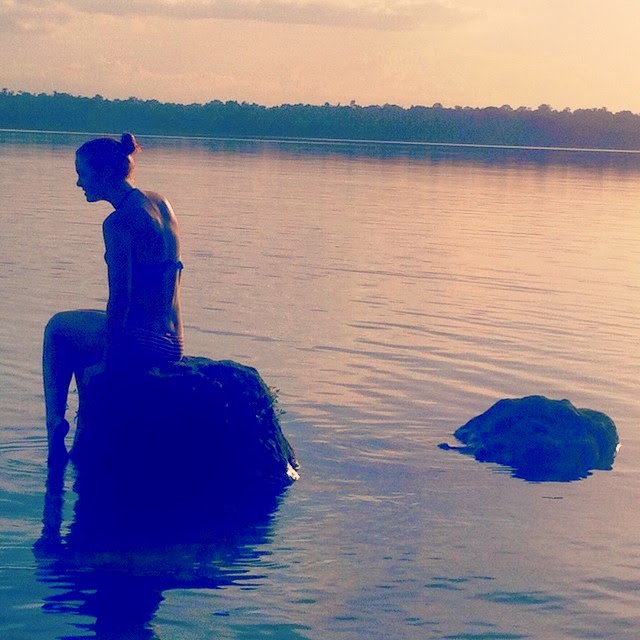
And the water. Impossibly turquoise, just cool enough to be refreshing after a 4km hike but far more ‘bathwater’ than ‘bucket shower,’ underscored by white sand and lined by dense palms and brush all around, the shoreline has a distinctly Caribbean feel. Glassy and darker in the morning, it brightens to almost luminescence by noon, and remains that way until reflecting the distinct pink and blue hues of the sunset around 6:30pm.


Park officials warn that swimming is not permitted more than 50 meters past the shore due to the abundance of crocodiles that call Laguna Lachua home. What they fail to warn you about is the hundreds of little fish of varying species that meander around the shoreline in little schools that have yet to learn how far down they are on the food chain and will nip at your legs and feet if you stop moving for too long. Swimming with them feels being followed around by a 3 year old who just discovered pinching yesterday- annoying, but certainly not dangerous.


We took a long, lazy dip in the lake before going to see our rooms. The park has a bungalow with about 6 single and double rooms with extremely comfortable beds (we’re talking REAL mattresses, guys!) and mosquito nets. The bungalow is as well run as the park- a stern though friendly gentleman will remind you to remove your shoes before going up the stairs, to dry off before entering your room, and not to stomp up the stairs too loudly. 


After a solid 3 days of work in the oppressive, sticky Santa Lucía heat, 3 nights of sleeping in my camping hammock, our 4 kilometer hike and an hour in the lake, I took a nap in that cabin like no nap I’ve ever taken before. The only thing that got me off it three hours later was the promise of another swim and the chance to see the sun set over Lachua.


The sunset was as beautiful as the following morning’s sunrise, and despite getting yelled at by our next door ‘neighbors’ for laughing a little too loudly a little too late, by 8am I felt like a whole new woman. The restorative waters had done their trick; I was ready to get back to work with a vengeance... Even though I would have loved to have spent another day in the water playing Little Mermaid.


DEFINITIVE GUIDE TO PARQUE NACIONAL LAGUNA LACHUA (LACHUA LAKE AND NATIONAL PARK)

When to go
March through May is the very warm, very sunny dry season, making it a great time to visit. June through November is rainy season, and December through February can get downright chilly (pack warm!). Weekdays are quieter; the weekends bring scores of Guatemalan families for day trips. 

What to bring
decent shoes (hiking) 
sandals (lakeside)
bathingsuit and towel
Bugspray and sunscreen 
Camping equipment (if needed)
FOOD! There is no food or water sold in the park, and very little sold around it.

NOTE ON FOOD: There’s an ample kitchen next to the cabin and multiple churrasquerías available in the camping area. If you’re interested in getting meat and veggies for churrasco (which you should because it’s pretty much the most magical thing ever after a long hot day in the sun and water), buy some in Cobán or head to the nearest mercado in Playa Grande/Ixcan before going to the park. Just stay on the microbus past Lachua for another 45 minutes until it reaches Ixcan. Once you’ve made your purchases, go to the main strip in front of Banrural and ask one the waiting microbuses which one goes back to Lachua. 

If you’re staying in the cabin, your needs are minimal- sheets and mosquito nets are provided and unless you’re visiting between December and February when temps dip a little lower, the sheet will be sufficient.

How to get there
Whether Guate or Antigua is your jumping-off point, all roads to Lachua pass through Cobán (unless you’re coming from the north, that is). I’ve made both treks alone multiple times as a solo female traveler with no incidents to date.

-From Antigua: take any private shuttle to Cobán (Q150-200/$20-25, 5-6 hrs). Ask the driver to drop you off at Estación del Norte, the small public microbus station on the north side of the city. 
-From Guatemala City to Laguna Lachua: The Monja Blanca is the most comfortable, economical option around (Q50-Q65/$6.50-$8.50), with the priciest offering roomy cushioned seats and a bathroom on-board. The bus drops you off directly in front of Estación del Norte. Visit http://www.cobanav.net/bus.php for schedules and station info.
From Estación del Norte (in Cobán): Just say the word “Lachua” to any of the men eagerly waiting to take your bags and follow them to the correct microbus. If you’re more of a Do-It-Yourselfer, look for a bus that says Playa Grande/Ixcan, and tell the driver your destination (Q50/$6.50; 3.5 hrs). The microbus drops you off directly in front of the park entrance.

Getting In/Staying (Prices):
Park Entry- Q10/$1.30 for residents, Q50/$6.50 for foreigners
Cabin- beds are roughly Q20/$2.50 for residents, Q40/$5.50 for foreigners
Camping- by far the most economical option! Q10/$1.30 for residents, Q20/$2.50 for foreigners
Note: dollar conversations provided for reference only - dollars are not accepted at the park

Around Lachua
Although accommodations are hard to come by and the tourist industry is pretty much non-existent as of yet, it's worth hanging out in the area for a few days if you can arrange it. This is deep in the heart of Maya  country, as far from the backpacker trail as you can get- Q'eqchi' is the primary language spoken and most communities surrounding the park remain without water, electricity, or even road access. 

Aside from countless beautiful little pueblos set amid lush green fields and tropical forests, there are a number of impressive caves, several clear rivers fed by Lachua to swim in, and an ancient Mayan city and salt production site from approximately 100-200 AD under active excavation nearby. 

ADAWA now offers home stays in Santa Lucía (the last town before the park) for tourists and volunteers, which to my knowledge is the only accommodation of its type for several hours each way. If you're interested in extending your stay around Lachua, email adawa.gt@gmail.com for more information. 


Sunday, May 11, 2014

A Mother's Day Confession

Happy Mother’s Day!

Confession: I am terrified, absolutely sh*t scared, at the thought of ever becoming a mother.

There is this common misconception about me, fueled by thousands of pictures of me cradling tiny infants in my arms, that I am dying to have children. That I need to be a mother. That there is this empty space within me that can only be filled with a child of my own.

7 years ago, that may have been true. I loved children. I had dedicated myself to working with them; had professionally committed myself to nurturing and supporting them. I could think of no greater joy than someday having my own.

...And then I began to work with moms.

What puts me off of motherhood is not that mothers are chronically exhausted. It is not that they have a tremendous amount of things to do while simultaneously caring for a small human being who seems bent on its own destruction. It is not the diapers, or the tantrums, or the atrocious teenage attitude (sorry, Mom!). It is not the 24 hour schedule or lack of appreciation that so many internet campaigns and mommy blogs decry that frightens me.

It is the pain I have seen on the faces of mothers when a hurt beyond their control befalls their child and they can do nothing to stop it. It is the acute realization of how woefully little say I will have in what happens to this tiny being that means more to me than any words could possibly explain.

Though I do not know their faces, I love my future children so much; these unborn, protected, beautiful shining beacons of innocence and potential floating somewhere in the ether, waiting for their moment of self-actualization when they will take form and be named and begin trudging uphill alongside the rest of us in this overwhelmingly beautiful and awful journey that is existence.

I love them so much that I want to keep them where they are simply because I can keep them safe there. 

Say what you will about the joys of holding your baby in your arms. I’m not yet confident in my ability to survive the experience of spending the remainder of my life with my heart walking around outside of my chest on its own two legs with a strong-willed and defiant (if maternal temperatment is any indicator) mind of its own.

I am terrified to be a mother because I don’t know if I can handle that, and am perpetually in awe of any woman who can. Mothers wake up every day, love something outside of themselves beyond measure, and manage to muddle through hours of work or housework or errands without having a full-blown panic attack over whether or not their little one (or big one) is going to survive another day.

Admittedly, the past few years have been a little tough for me, as a woman and future mother. Beautiful, rewarding, enlightening, but tough. I loved and let go of the most amazing little person I’ve ever met. I’ve worked with moms going through the kinds of maternal hell most of us shudder at the very thought of. I’ve said goodbye to little babies I loved very much, knowing that the pain I felt at their loss was negligible compared to the pain their loving mothers felt. 

If I seem overly focused on the ‘worst case scenarios’ of motherhood, it’s because I’ve been deeply affected by seeing them played out by characters I’ve come to know and love. Motherhood is beautiful, but fundamentally terrifying.

So rock on, moms. Each and every one of you is far tougher and stronger than I. I will continue loving your children and being a part of the ‘village’ that nurtures them; laughing with you at their adorable antics, celebrating their accomplishments both big and small, and sharing in your sadness and pain when life is hard, or cruel, or unfair to them.

And to my own mom, who not only nurtured me when I was teeny-tiny but stayed strong for me throughout my own years of sickness, pain, and self-destruction; who spent countless nights sleeping beside me to make me feel safe, secure and loved; who took time off of work and drove hours each day for months at a time to get me the care I needed to get through my darkest days; who bore so much pain in birthing and raising me and worrying about me, only to have me grow up and give her more grief and worry by stubbornly moving thousands of miles away to follow my dreams- thank you. 


Today and every day, I have nothing but respect and admiration for you all.

Monday, March 31, 2014

Love is Hard


Beto at Casa Jackson, 2012.
Photo ©Joseph Labelle
 In the midst of a busy Tuesday morning at Casa Jackson, the doorbell rings. Half-sitting, half-standing at the computer, I am sifting through a pile of to-do lists, community nutrition education materials, and volunteer applications when I realize that I should probably let whatever parent or visitor has arrived inside.

I walk briskly to the door, opening it with my standard “Yes I am a foreigner, please don’t be frightened, your children are safe here” smile and soft-spoken Hello, welcome, please come in. 

A petite knob-nosed woman, clad in flip-flops and a worn, stained tee-shirt over her patterned skirt steps inside. With civility, warmth, and almost flourish, she introduces herself and her companion. As she speaks, a vague memory of this face resurfaces.

Good morning, I’m the mother of Alberto, and this is his aunt. I am here to visit my son.

So many emotions are rocking me, I don’t even know which to go about hiding first. I take a deep breath, smile a little too widely, and greet her enthusiastically.

How wonderful that you’re here! He’s growing very well... a very smart and beautiful little boy. Please, come in, come in.

As I feel my mouth move around these words, my heart drops to my gut and I feel it pulsing and throbbing there. An inner protest begins to mount, quietly at first, until it crescendos to the pitch, volume, and frequency with which my little Beto, her little Beto, the two-foot-tall miracle at the center of it all, demands my attention whenever I need to speak to a tour group or important guest... no no no no no NO NONONONONONONONO. 

I want to cry. 

******************

In the year that I have been with my little boy, I have only once met this woman. She comes to Antigua weekly for a food distribution, only ten minutes down the road. She does not visit him; she does not call. His father, during Beto’s intake, informed the nurses that ‘If he dies, he dies. We’ve got other ones.’

Beto’s older brother died in Casa Jackson a year before he was admitted, 6 months younger yet weighing still more than Beto did upon on arrival. There are now three children, including Beto, left. I wonder how many he would have to lose before their individual lives begin to hold value.

His parents informed the hospital months ago that they don’t want to take Beto home. ‘You can keep him,’ they say. They do not try to explain or justify their choice. They simply let us know he is ours to care for now.

Two weeks ago, the nurses asked me if I will take Beto in when he leaves the hospital. I am scared; I am overwhelmed. I am unsure if I am ready for such a big step. The association’s lawyer assures me they will help work out the legal issues surrounding him being placed in foster care with me. 

I have said yes. I am scared, but I am happier than I have ever been. It is a new level, a different plane of joy. I am realistic about the sacrifices and challenges ahead. There is nothing I wouldn’t give up to keep this little boy safe, happy, and loved forever. 

Beto and I talk often about the fun we’ll have soon, when he can leave the hospital and come home with me as he begs to do each evening. We make plans together. He asks me if he’ll have to come back to the hospital to sleep. I tell him no. His face lights up and he squeals in delight. He wants Elmo pajamas, and bubbles, and to eat chicken soup with rice for dinner. He has asked for bedtime stories, and crayons, and to ride in a car from time to time. He wants to go to the zoo. 

******************

As his mother and aunt dress themselves in the requisite hospital top and surgical mask, I rapidly ascend the stairs. I find Alberto on the third floor, playing with a new volunteer. He is standing, digging through a toybox, and as he turns, I have the joy of watching his face at the moment he realizes I’ve arrived. He shouts my name and shuffles over to me in his pink pants and tiny Crocs, arms outstretched, giggling.

In one quick motion, I lean down, pick him up, and smother him with hugs and kisses in my arms. 'Good morning, sweetheart! I love you!'

We greet each other as we do each and every day; gleefully and without abandon, relishing those brief moments each day where we belong to each other, and only each other, before babies must be fed or diapers changed, before scheduling or emails or program planning steals me from us.

I kiss his nose and forehead repeatedly as I try desperately to feign happiness and excitement. He hasn’t seen her in so long. Will he remember her? Will he be nervous to go to her? Will he choose her over me?

I grapple with a rising jealousy; a fear that for how inseparable we are, for how he sees me as “his;” for how his sun rises and sets over my shoulder; for all of that, I fear that he will be thrilled to see her. That he will cry when she leaves as hard as he cries when I leave. That when she leaves, he will repeat her name as he does mine: 'Amy Amy Mama Amy Mama Amy...' 

I may be his mama, but I am not and will never be his mother. I cannot fight biology. I love him beyond measure, but it is not my love or my body that brought this shining little light into existence.

How much easier this love is when it’s just the two of us, the other babies, and my humble little staff of nurses and volunteers. It hurts then, but not to this depth. 

It hurts to hear him cry as I sit in my office, knowing that he wants only my arms to comfort him, torn between the ‘greater good‘ of completing whichever priority on the current mountain of tasks must be done for the day and the good that is most crucial to me- that of his comfort. Of his well-being. 

It hurts to leave him behind each day, to eat dinner alone, wishing only that I could make him a grilled cheese cut into hearts for supper before giving him a long bath in which he can splash and play, and then tucking him into bed and reading his favorite books. It all hurts... But this, this is new.

'Beto, your mom is here to see you. How fun! You’re going to play with your mom... You’re going to say ‘hi mama!’ and give her a big hug. Are you excited?'

My heart begins to criss-cross with hairline fractures as I watch my little boy processing this news. He is not happy. He is not sad. He is quiet and somber, and peers quite seriously and intently into my eyes as he slowly nods. I pull him to me again and rest my lips on the top of his head, square in the center of a whorl of soft jet black hair, pressing down the cowlick that persistently pops up after bath-time.

I walk down the stairs with him. As we round the corner of the stairwell, his mother is ascending from the first floor. We come face to face. I smile and give Alberto one final, reassuring squeeze before passing him to her, arms open, awaiting this child that is rightfully hers. Alberto looks quizzically at me as he goes to her, but does not resist, and in that moment I know he remembers.

She holds him at her hip, facing her, and he stares up at her with his Very Serious Face.  He is not speaking. He is not smiling. I feel like I’m gripping a live wire with both hands, tension coursing through my body. I am sick. I need to step away before I give in to the urge to rip him from her arms and sob desperately 'mine mine mine.' 

I go to the laundry room and begin putting away a basket of clothing, taking deep breaths as I fold bibs and onesies and tiny sweaters for premature babies. I feel indescribably guilty. This woman, this poor woman who has faced more hardship in her life than I can ever begin to understand, it is this woman who I want to edge out of her own child’s life- for his safety, to be sure, but still... As a woman, a future mother, a human being, we are too close now. She is not That Woman Who Almost Let Him Die and Has Abandoned Him... no, she is, once again, his mother.

And me, who am I? Who am I to bear this massive responsibility; this right to say which poor, uneducated parents deserve to keep their child and which do not? A young foreigner, not even a parent myself, who tries desperately but will never truly grasp the suffering my patients’ mothers have endured. As I pair tiny socks, I begin to drown in the shame of my own righteousness.

I hear footsteps behind me, and before I see or hear him, I know he is in her arms, looking for me. I turn and see his thin arm outstretched, index finger pointed at me, face growing more desperate. He is seconds away from crying. His mother walks towards me, irritated. I put my hand up to his cheek and he grabs it with both hands, entwining his fingers with mine, and pulls me towards him.

'Beto, it’s time to play with your mother... I’ll be here after, I promise. It’s time to visit with her now. We’ll play together later, sweetheart, later.'

It is not his tears or his cries that ruin me in this moment. It is the way he clings to my hands, clawing at them as I free one finger at a time, only to find another trapped in his tiny hand.

It is the look on his face; this confused, sad, desperate look. It is the pain I see in his eyes, the betrayal he feels right now. I am his security blanket, his comfort... and I am walking away. 

He is staring at me with wild eyes sobbing, arms outstretched, calling to me- ‘mama amy mama amy amy mama.’ 

I smile and apologize to his mother.

I go downstairs, sit in my office and pretend to work. I pull up documents and schedules and to-do lists and I try to make sense of them. I am emotionally dizzy, spinning with this horrible heartache and these empty arms and this sickening guilt and shame and the rising fear that she is here to take him home. 

I am not a ‘believer.’ I find myself praying for the first time in years. Dear God, don’t take this child, don’t let this child die like his brother, don’t take him from me...

An hour after arriving, she leaves. I hear the heavy door click shut behind her and walk up the stairs to find Beto sitting on the mat in front of the nurse's station, a blank stare on his face. He looks at me as I kneel down in front of him.

He crawls onto my lap, wraps his arms around my neck, and sighs one word onto my chest. 


'Mama.'


Beto celebrating his 3rd birthday at Casa Jackson, 15 months after arriving near-death.

Friday, March 7, 2014

Fighting Adult ADHD... and Child Mortality in Guatemala's Q'eqchi' Community (at the same time)

Beto was 22 months old and weighed 13 lbs upon
admission to the hospital for acute diarrhea and a parasitic infection.
Access to clean water, waterborne illnesses, and malnutrition
are closely linked in the developing world.

My family and friends have heard me lament about my ceaseless struggle with (rampant) adult ADHD- a puzzling misnomer, as ADHD begins in childhood. Despite years of learning to force productivity from a brain as rebellious and petulant as a 16-year-old girl, I still flounder every time I’m faced with a structured task or a deadline. My ADHD is both the biggest challenge I face in my career, as well as the greatest strength I bring to the table. 

Thanks to my ADHD, I monitor traffic through 8 different train stations within my brain, each consumed with a different problem or potential project, watching hundreds of thought trains come and go, directing the most coherent, promising ones to the next track for further consideration. Due to the sheer number of thoughts I can have simultaneously, I can multitask, problem-solve, and brainstorm like a boss.

This week, however, it's been a burden. Despite my excitement and dedication to ADAWA (our website and Facebook page have finally gone up, take a gander!), I am having a hard time slowing the thought trains down enough to record the information they’re carrying. And I need to. I really, truly need to. Because the task I’m working on is important, and relevant, and a small but critical first step towards reducing rates of child mortality and improving health in our region.

During the first week in April, I’ll be delivering interactive workshops to different audiences in Santa Lucia Lachua. Due to low literacy amongst participants (save for formally educated health workers) and their primary language being Q'eqchi', the workshops need to be highly visual to ensure participants leave with a good understanding of the information they have asked me to present. As someone who relies heavily on the written word to express myself, this poses a great challenge for me and my disobedient brain. 

Last night, as I sat with my laptop, fighting to keep my eyes, thoughts, and typing fingers at least loosely united, twenty tabs open to gather various bits of information, my eyes fell on the following statistic:

“2,195 children die daily from diarrhea- that’s like losing 32 school buses full of children each day.”


32 school buses full of children die every single day, because they lack access to clean water and a $3 course of antibiotics. This is like the entire elementary school population in my small town passing away in one day- three times over. 

How many of those children are coming from our little corner of Alta Verapaz, where entire Q'eqchi' communities lack access to clean water and the knowledge needed to prevent their children being infected by contaminated water? Judging by the statistics I received from the oil company’s part-time doctor- yes, believe it or not, in Santa Lucia Lachua the local oil company is the good guy, and currently runs the only clinic in town- a lot. Of the 75 children seen in January, over 50% were seen for diarrhea, amoebas, and parasitic infections.

It’s amazing how one sobering fact can refocus a runaway mind so quickly. I was humbled, reminded that while this workshop may be a struggle for me to develop, it is pathetically small compared to the struggles faced by the women I will be delivering it to. Women who routinely lose their infants and youngest children to something entirely preventable. Women who are doing their very best to keep their children healthy, knowing how deadly ONE bout of a common childhood illness can be. Women who want to learn how to protect their children, and are hoping I can teach them.

While my brain may go awry from time to time, it’s "aha" moments like last night's that help me keep all those trains on track. The simple act of teaching women how to protect their families from waterborne illnesses while helping them gain access to cleaner water saves lives. 

Since I began in nonprofit, many have told me "I could never do what you do."  Days when my brain is on the fritz, I really don't feel cut out for it either. But the reality is that simple measures save lives. All the time, effort, and investment is worth it. Healthy communities that aren't fighting to survive preventable illnesses have the energy and attention to devote to their own long-term, sustainable development. Our communities want to- and we want to make sure they're able. 

In addition to delivering health education, our BIG goal for this year is to put a well at each of the 34 schools in our area, and get a water filter into every school and home. Wells ensure that kids no longer have to drink from contaminated rivers at lunchtime, and that each community has a well for public use. Filters ensure that the water they drink will no longer infect them with deadly waterborne illnesses.

If you happen to be interested in helping us, we're gratefully accepting donations for the well project. $125 purchases all materials needed to construct one well, though any amount is greatly appreciated. For a 'newly minted' project such as this one, even small amounts make a big difference. In keeping with our commitment to foster collaboration and teamwork throughout the region, communities that have already built wells send teams to teach, mentor, and assist other communities as they build their own. 

Thanks again to all who are taking the time to read these posts. Some days it's a struggle to sit down and write them, but knowing that even a handful of you are following along helps me wrangle my brain train into the station. :)

Friday, February 28, 2014

WHERE and WHY? aka, Beginning to Answer the 4 W's (Part 1 of 3ish)

Sweat beads under my heavy cotton ADAWA teeshirt, granted graciously but unceremoniously to me minutes before our meeting with the local clinic workers and community leaders. 'It may help for you to look official,' Don Ramiro explained; 'it will show the community that you're not from the government or any other organization; you're just here with us, to help us.'

I shift in my hard plastic chair and glance at Don Ramiro, waiting for his signal. The mid-morning heat is quickly becoming oppressive in this modest concrete office the local government permits the association use of, in place of Santa Lucia Lachua's subpar 'community center'- a lumpy dirt pavilion with a tin roof (and no chairs). 

I glance down at the questions I've prepared for this meeting, called by Don Ramiro on my behalf, to gather information about the community's health needs. As he gestures dramatically and makes what Tara and I can only guess are further assurances of our good intentions in the distinctive Q'eqchi' that is the native, primary, and often only language of his community members, my confidence falters. In a country brutalized by a 30-year-long civil war, where the mere suspicion of dissent was enough to endanger one's life, indigenous communities are not known for their willingness to openly and honestly complain about the government's failures. I steel myself for silence and prepare to spend the next three hours subtly prodding participants for the information I need.

Don Ramiro turns to me and breaks into a grin that illuminates his round face. "Alright, then. You can start with the questions." I smile at the thirty stern faces in front of me, some nodding in acknowledgment, some unmoving with eyes cast to the floor, and begin. "I'm interested in learning about the medical care you provide to your communities, and any struggles you may face in trying to provide it. Is anyone interested in speaking about this?"

Don Mario clears his throat. A thin, wiry man clutching a red backpack on his lap, Don Mario has been giving Don Ramiro his rapt attention, nodding throughout the lengthy introduction and jotting down notes as he listens. He raises a hand in the air, pushes a smudged pair of glasses up the bridge of his nose, and begins.

"There are 22 FCs (community health workers) working in 10 clinics, serving 34 communities. We are paid Q500 ($62.50) per month to work in the clinics. Depending on the size of the community, we have support from a doctor, nurse, or practical nurse. Some communities have a nurse every day, others only once a month. Clinics in smaller communities are open one or two days a week, or whenever someone needs care. In most clinics, FCs provide all the direct patient care. Sometimes we have enough medications to treat the conditions that are hurting our community; sometimes we don't. 

Our jobs were difficult before, but in November, the candidate we voted against won the local elections. To punish us, he stopped paying our salaries, stopped giving us money for medication, and locked all the clinics. We still see patients when they need us, and give them whatever medications we have left. We could lose our jobs if they found out, but we do it because our community needs us. We found out today that the clinics will open again, but only half of the FCs will have jobs. We'll only have 11 people to care for the 12,700 members of our community."

As Don Mario speaks, the sea of somber faces begins to awaken. Other FCs nod their heads vigorously, murmur in agreement, and interject with complaints of their own. Don Ramiro can barely keep pace with his translation as clinic workers and local leaders from 18 different rural villages echo the same anger, sense of abandonment, and concern for the communities they serve. Far from being met with silence, I am confronted with a room full of people eagerly vying for their turn to be heard.


                            *********************************************

While I initially signed on to collaborate with ADAWA under the auspice of supporting public health, my new role in the project is significantly more expansive. I will be working with an association comprised of 400 members of the indigenous community to coordinate projects that bring long-term, sustainable development to a highly marginalized region. The underlying, central focus of the projects we implement is to empower each community to take responsibility for its own progress, improve cooperation between the region's 34 communities (where competition for scarce resources leads to strife), and develop strong local leaders that can advocate for and advance the development of the region from within.

While informative, that explanation does little to paint a picture of what ADAWA is actually doing to accomplish our goals. It also fails to explain the context of where we operate, why the support is needed there, and how we aim to accomplish our goals. I'll address the where and why first, as both are irretrievably intertwined.

Working in health, human services, and nonprofit, marginalization is a word I have heard and used often throughout my career. Marginalization is oppression accomplished through social, political, and economic exclusion. Every nonprofit I've worked for, both in the US and Guatemala, has expressed a commitment to 'empowering the marginalized.' But beyond the rhetoric, beyond the feel-good mission statements justifying our work, what does it mean to be marginalized?

mar·gin·al·ize: to put (or keep) someone in a powerless or unimportant position within a society or group. (thank you, Merriam-webster.com!)


Americas Quarterly completed their updated Social Inclusion Index in 2013, scoring 16 Latin American countries on their progress (or lack thereof) towards social inclusion. In AQ's words,

"At its most basic, social inclusion is about opportunity: it represents the combined factors necessary for an individual to enjoy a safe, productive life as a fully integrated member of society—irrespective of race, ethnicity, gender, or sexual orientation...  including the factors that allow for a citizen to express himself or herself to demand change and a reasonably accountable government that will respond to those demands.


This touches on a wide range of factors that... encompass, of course, economic growth, social spending, reduction of poverty, access to education and other social services, and access to formal employment. Also included are measures for the respect for basic human, political and civil rights, as well as the extent to which citizens participate in civil society and the perceived responsiveness of government." 

Social inclusion is essentially the opposite of marginalization. By all accounts, Guatemala boasts one of the most marginalized populations in the Western Hemisphere. Indigenous Maya comprise well over 40% of the nation's population, but are routinely denied access (inclusion) to quality education, healthcare, and opportunities for economic advancement; they are treated as second-class citizens and largely ignored within the political process. As a result, 75% of the nation's indigenous population remains impoverished.

As expected, Guatemala (which also ranks 131 out of 187 countries on the UN's Human Development Index, comparing literacy, life expectancy, education, and overall standards of living worldwide) performed poorly on the AQ's index. Of the 16 countries surveyed, Guatemala ranked last in overall social inclusion as well as women's rights. This is no surprise in a country that boasts some of the highest levels of chronic malnutrition and government corruption, and lowest gender equality and literacy levels, in the Western hemisphere.

In order to begin to understand how nearly half a country's citizens can remain so oppressed while others advance, the region's history must be addressed. From the arrival of the conquistadors and the Spanish empire in the early 1500's, the Maya have been subjugated, brutalized, enslaved, and oppressed by one group after another. Early European settlers and later US-based companies like United Fruit Co. bought up large swaths of land for coffee and fruit plantations, creating a system of indentured servitude for most indigenous Guatemalans and cementing their place in an already racially stratified society.

A CIA-backed military coup in the 1950's sent democratically elected president Jacobo Arbenz- whose recent land reform had redistributed uncultivated, privately-owned land to the working poor- into exile, and plunged the country into a 30-year civil war. The military waged war against leftist guerrillas, mostly indigenous Guatemalans, who aimed to overthrow the military government and return to a democratic governance that would give the indigenous community equal rights and opportunities for advancement. Anyone who expressed dissent, showed an interest in their own civil rights, or participated in any sort of community organization could be labeled as a guerrilla and slaughtered at will. 200,000 died during the conflict, with hundreds of thousands more displaced. Entire villages were brutally massacred and razed to the ground as part of a governmental policy of genocide against the Maya. While peace accords were signed in 1996, the country remains deeply affected.

Despite increased awareness and advocacy for indigenous rights and a growing body of indigenous activists, the corrupt but powerful government, still backed by an elite aristocratic minority, have done a remarkable job of ensuring that entire swaths of the country remain uneducated, disempowered, and struggling to survive. The simple truth is, and always has been, that an organized, empowered indigenous community is too strong a threat to those that hold the reins of economic and political power in Guatemala.

This is what marginalizaton is, and how it happens. But what does it look like for the hundreds of thousands of Guatemalans affected by it?

It looks like most rural communities within the poorest departments of Quiché and Alta Verapaz, where only 20% of indigenous children enroll in primary school (completing, on average, 2.1 years of formal education before dropping out). Communities where 50% of mothers have had their first child before the age of 17, and have lost or likely will lose at least one child to an entirely preventable and treatable illness like pneumonia or diarrhea; where chronic malnutrition rates remain high due to a lack of education and basic medical services, despite access to arable land and a favorable growing climate.

It looks like the many places far from the country's bustling capital without accessible, paved roads; without access to uncontaminated water for drinking and bathing; without educational and economic prospects. Places where elected officials can penalize a whole region for exercising their constitutional right to vote freely, and deny them the opportunity to receive basic services they desperately need.

It looks like a place where indigenous legislators make up a mere 13.9% of Congress, though they represent over half the population. A place where previous attempts at organizing and empowering locally from within have resulted in government destruction of property and the brutal murder of community leaders, leaving deep psychological scars on every member of the community.

It looks like a place where entire communities sit in wait for either the government or foreign charities to come and 'save' them, because they do not believe they are capable of advancing from within. A place where the long-awaited 'savior' NGOs run development initiatives for a year and then leave, turning responsibility and control over to community members, only to see them abandoned because, as we heard time and time again during our visit to the area, "we had no leaders here to run it."

It looks like our community:


A main road in Santa Lucia Lachua, where ADAWA is based.
(The recently paved Northern Transversal highway passes
through town but is only used for travel in/out of the region).

A mother washes her children's laundry using water from a makeshift 'well'-
a hole dug into the ground, sides reinforced with mud and plywood, that
captures rainwater and runoff from a nearby contaminated stream. This 'well'
also serves as a source of drinking water for the family.

The outhouse at Santa Lucia Lachua's only school, which serves students
from 1st through 7th grade (though many drop out before that). This basic
concrete and tin outhouse is actually more advanced than the open-air,
thatch-roof, 'hole-in-the-ground' latrines utilized by even the
comparatively well-to-do families in the community.

Wednesday, February 19, 2014

So About This Whole Moving Home Thing...

The sound of howler monkeys and the singing of the evangelical church next door compete until the rain begins- a steady, roaring downpour that lulls me to sleep almost instantly. I wake hours later to the same sound, content beneath the canopy of my mosquito net, and listen to Aura and Doña Juana's sing-song banter in the next room, separated from us by a plank wall that stops 5 feet below the corrugated tin roof, punctuated by the slap-slap-slap of their hands forming the first batch of the day's tortillas.

It is my third morning in Santa Lucia Lachua and I am already in love.

The past two days have been inspiring in a way that gives new meaning to the word. I am honored and humbled to work alongside a true visionary; a man who works tirelessly from morning until night, without pay, to organize and uplift not just his community but the 33 other communities that fall within ADAWA's area of influence. He is a hard worker who spent years rising hours before dawn and walking from the highlands down to the campo to put in hours of backbreaking labor in the fields, so that someday he could realize his dream of owning enough farmland to provide security for his family. 

He is a devoted father to his 10 children, all of whom have attended not just primary school but university (which is no small feat or expense in this poor, rural community located far from the department capital), and a loving abuelo to his 3 grandchildren, who will receive the same opportunity in the coming years.

In addition to being a devoted community member and family man, Don Ramiro possesses a deep insight into the challenges faced by his community and region, one of the most marginalized in a country notorious for socially and politically oppressing the indigenous community. His counsel is worth its weight in gold for Tara and I, the two young gringas who stand heads above most of ADAWA's 400 members and struggle to understand, let alone speak, the halting, guttural Q'eqchi' that is the native (only) tongue of most members. 

His fellow community members find him as indispensable as we do; his advice and mediation are sought in almost every dispute or disagreement that arises between communities (of which there are many). In the first 48 hours following our arrival, Don Ramiro had 3 meetings with a nearby community who has blocked a public path that crosses onto their land for a mere 15 feet, preventing some members of Santa Lucia Lachua from reaching their own fields further down the path. He has arranged, attended, and translated a 3-hour-long meeting with 30 local health workers for Tara and I's benefit, and spent every meal collaborating with us on future plans for this fledgling association that is truly unlike any I have encountered in my three years of exposure to Guatemala's NGO scene.

                                                *******************************

          When I arrived back in Antigua in September, I wasn't sure if I wanted to stay. I simply knew that I wasn't feeling happy or productive where I was (living and working back home), and that the winter was fast approaching. Antigua was the last place I had felt genuinely happy, and thus seemed like the logical place to return to in search of the feeling. I missed having not just a 'job,' but a purpose- a project to throw myself into with complete and utter abandon. I missed the exhaustion and exhilaration of attacking an insurmountable challenge. I missed my work.

I returned to a slightly different Antigua than the one I left, which is not uncommon in a small town whose fabric is unraveled and rewoven every three to six months with the ongoing exodus and arrival of old and new faces. My closest friends remained, but without a real job to anchor myself to, I felt the strain of the late nights, partying, and constant comings and goings of the people I interacted with on a  daily basis. For all my excitement to return, I found myself paralyzed with fear to jump back into the professional arena, no longer romanticizing or amnesiac about the severe emotional toll that the trauma I dealt with on a daily basis in my previous position had taken on me.

After several months of feeling lost and unhappy for various reasons and a particularly rough holiday season, I made the decision to move back to the states. I accepted that my life was heading in a different direction and that perhaps it was time to shelve the dreams I had held for so long in favor of a more 'logical' path. I enlisted the help of my boyfriend and planned a surprise visit home in January to ease my homesickness and make the announcement to my family in person. I was incredibly excited to be coming home, ecstatic that I could soon begin seeing my loved ones on a regular basis again, rather than every few months, and cease feeling like I'm missing out on so many precious moments in their lives.

A few weeks before my scheduled departure, a friend mentioned in conversation that she had begun working with an association up in Alta Verapaz. As she shared details of this new endeavor, her excitement was palpable, and after listening to her for several minutes it was easily apparent why. Knowing my background in community health, we discussed the possibility of me visiting the area and planning a nutrition workshop prior to my departure. I walked away from that conversation feeling refreshed, light, energized. I felt like myself again.

Over the course of the next few days, as we continued discussing the details of this project, I became more and more captivated by how unique and unconventional it was. I walked away from each conversation with my head spinning with ideas about how to apply my experience in pursuit of the association's goals, and began to feel that familiar pull to dive in, headfirst, and submerse myself in it.

After a genuinely heart-wrenching week of indecision, I accepted and admitted to myself and my loved ones that I simply could not pass this opportunity by. I could not leave Guatemala. For all the fear and self-doubt I have carried with me over the past several years, I still believe in myself, my abilities, and my dreams. Above all of that, I believe in Don Ramiro and I believe in the vision that he and his community share for their future.

For those that were eagerly awaiting my move home this weekend, having patiently said goodbye to me countless times and tolerated several years of long absences, I am sorry to let you down. I think most of you have already accepted my lifestyle, although I still struggle to accept that the pursuit of my dreams prevents me from partaking in the daily life of so many of my loved ones.

I have never been more excited, or more proud, to be a part of anything as I am to be a part of ADAWA. The potential that this project has is immense; the model, inspiring. There will be innumerable challenges, but I genuinely believe in the power of this community to organize, empower, and develop themselves from within, when given the support they are so earnestly seeking.

MANY more details to come over the next few weeks... I hope that with each update, you'll grow to love this project and our community as much as I do. Thanks to all who followed my last endeavor so closely, and also to my family and friends back home for continuing to love and support me from afar.

B'antiox, everyone ('thank you' in Q'eqchi'). Another adventure begins :)